


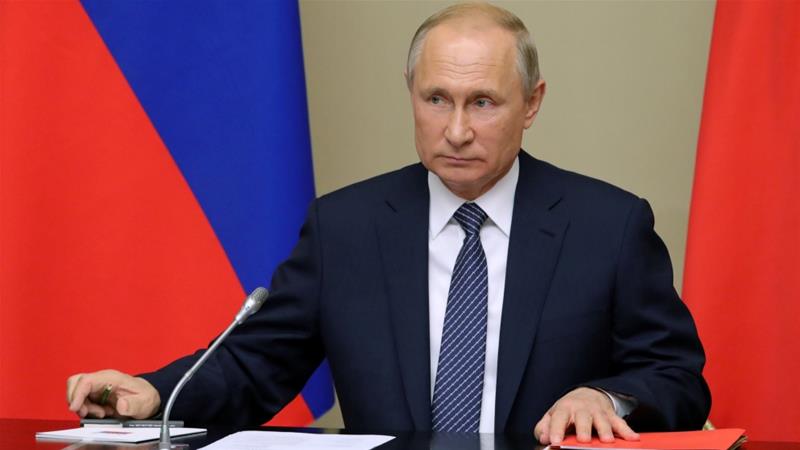
Statement by the President of Russia on the unilateral withdrawal of the United States from the Treaty on the Elimination of Intermediate-Range and Shorter-Range Missiles, August 5, 2019
On February 1, 2019, the United States of America launched a procedure to withdraw from the Treaty on the Elimination of Intermediate-Range and Shorter-Range Missiles. The six-month period set forth in the Treaty’s withdrawal clause has expired. When one of the parties withdraws from the Treaty, it ceases to have effect automatically. Therefore, as of August 2, 2019 the INF Treaty no longer exists. Our US colleagues sent it to the archives, making it a thing of the past.
It is with regret that Russia states that the unilateral withdrawal by the United States from the Treaty on the Elimination of Intermediate-Range and Shorter-Range Missiles under a far-fetched pretext and the dismantlement of one of the last fundamental arms control treaties creates major complications for world affairs and brings about serious risks for everyone. Let me emphasise that all the responsibility for what has happened rests with the United States. Instead of engaging in a meaningful discussion on international security matters, the United States opted for simply undercutting many years of efforts to reduce the probability of a large-scale armed conflict, including the use of nuclear weapons.
Russia cannot ignore the current state of affairs or satisfy itself with hollow peace-loving declarations made by its American colleagues or their allies.
In this context, considering the current situation, I instruct the Defence Ministry, the Foreign Ministry and the Foreign Intelligence Service to monitor in the most thorough manner future steps taken by the United States to develop, produce and deploy intermediate-range and medium-range missiles.
If Russia obtains reliable information whereby the United States completes the development of these systems and starts to produce them, Russia will have no option other than to engage in a full-scale effort to develop similar missiles. Of course, this will take time. Until the Russian army deploys these weapons, Russia will reliably offset the threats related to the withdrawal by the United States from the Treaty on the Elimination of Intermediate-Range and Shorter-Range Missiles by relying on the means that we already have: the X-101 and the Kinzhal air-launched missiles, the Kalibr sea-launched missile, as well as future weapons systems, including Tsirkon-class hypersonic systems. At the same time, Russia maintains the unilateral commitments it has assumed, and will act only when it has to respond. This applies to developing, producing and deploying land-based intermediate-range and shorter-range missiles. We will not deploy them in any given region until US-made intermediate-range and shorter-range missiles are deployed there.
Despite the recent developments, Russia still hopes that common sense prevails, and that our US colleagues and their allies have a sense of responsibility toward their people and the entire international community. It is our belief that the actions taken by the United States that brought about the dismantlement of the Treaty on the Elimination of Intermediate-Range and Shorter-Range Missiles will inevitably devalue and shatter the foundations of the global security architecture, including the Strategic Arms Reduction Treaty and the Treaty on the Non-Proliferation of Nuclear Weapons.
This scenario could signal a new start for an unfettered arms race. In order to avoid chaos with no rules, restrictions or laws, we need to once more weigh up all the dangerous consequences and launch a serious and meaningful dialogue free from any ambiguity.
Russia considers that it is necessary to revive without delay meaningful talks on ensuring strategic stability and security. We are ready to engage in these efforts.
Foreign Ministry statement on the withdrawal of the United States from the INF Treaty and its termination-FR1
On August 2, the United States completed the withdrawal from the INF Treaty. Accordingly, this instrument ceased to have effect.
Washington has committed a grave mistake. By launching a propaganda campaign based on deliberately misleading information on what was presented as violations of the INF Treaty by Russia, the United States intentionally plunged the Treaty into a crisis that was almost impossible to overcome. The cause is however clear: the United States wanted to free itself from the existing restrictions.
For many years Washington showed blatant disregard for Russia’s serious concerns regarding its compliance with the INF Treaty. The deployment at US military bases in Europe of Mk 41 launchers that have the capability to launch intermediate-range cruise missiles was already a grave violation of the Treaty.
Instead of reviewing mutual concerns in a meaningful and professional manner, the United States issued ultimatums against Russia that were unacceptable by definition. All our proposals regarding viable solutions to settle the existing problems based on mutual transparency measures were turned down.
The representatives of the United States hypocritically invoked considerations whereby the INF Treaty was obsolete and needed to “involve third countries.” While making these claims, they were clearly aware of the fact that the countries in question were not ready to assume the relevant treaty obligations.
Therefore, through its purposeful actions the United States first undermined the INF Treaty, and then moved to set the stage for its definitive breakdown. This is not the first time Washington has acted this way. This misguided attitude can be traced back to the late 1990s and the decision by the United States to dismantle the ABM Treaty despite insistent calls by the international community not to do so.
By denouncing the INF Treaty, the United States confirmed its commitment to abolishing all international instruments that do not suit it for one reason or another. This leads to an actual dismantlement of the existing arms control architecture.
With the INF Treaty no longer in force following Washington’s withdrawal from it, immediate steps to stabilise the situation and preserve the necessary level of predictability in Russia’s relations with the United States have to be taken. Russia has gone its part of the distance. We have already introduced a moratorium and will not deploy land-based intermediate-range or shorter-range missiles, should we acquire any, in the regions where the United States will not deploy its intermediate-range or shorter-range missiles.
We call on the United States to renounce deploying missiles of these classes, and it is unfortunate that the Pentagon has been proactive in communicating on their development. We call for following Russia’s example by taking the necessary steps to ensure global stability and predictability. Otherwise, all the responsibility for escalating tensions across the world will rest with Washington.
Russia remains open to equitable and constructive dialogue with the United States for restoring trust and strengthening international security. We hope that the United States adopts a responsible approach to this matter.
Deputy Foreign Minister Sergey Ryabkov’s opening remarks at the briefing on the termination of the INF Treaty, Moscow, August 5, 2019
On August 2, six months after Washington initiated the withdrawal from the Intermediate-Range Nuclear Forces Treaty signed by the USSR and the US in 1987, the treaty has been terminated for all parties: the US, Russia, Belarus, Kazakhstan and Ukraine.
This means that a key treaty for establishing the regional and global security architecture no longer exists. Under the INF Treaty, the parties eliminated two classes of nuclear armaments: land-based intermediate-range and shorter range missiles. The missile launchers and all the associated support facilities and equipment were also destroyed.
Washington’s withdrawal from the INF Treaty has dealt a great blow to the arms control system, which took decades to build. Far-reaching negative consequences for the entire architecture of global security and strategic stability are inevitable.
The US is entirely to blame for this. It was the American side that buried the INF Treaty by launching and completing the procedure for its unilateral withdrawal, while Russia consistently protected the treaty until the very end. In fact, it is completely incorrect to say that Russia has also withdrawn from the treaty and shares the responsibility, as some foreign officials and several media do.
Russia did everything possible to save the INF Treaty. In recent years, as soon as the US began moving towards the withdrawal from the treaty, we tried many times to start a constructive conversation with the Americans. We proposed a number of initiatives that would have made it possible to resolve the claims from both sides and save the INF Treaty. Russia was transparent beyond the treaty’s provisions.
However, all our efforts were ignored or turned down by Washington. Unfortunately, the US’s true goal was not to keep the INF Treaty but to get rid of the bans and restrictions on the buildup of the US missile potential. The US was purposefully working to untie its hands so that it can use an unlimited range of military tools to exert military pressure on any rival or opponent in the world.
The US deliberately plunged the INF Treaty into a crisis that was almost impossible to overcome in order to cover its actions. Instead of a professional and detailed discussion of the acute issues we were insisting on, they decided to dramatically escalate the situation. A misleading and irresponsible propaganda campaign was launched against us as a smokescreen as Washington tried to distort everything and present the matter as if the US is withdrawing from the Treaty due to Russia’s behaviour.
The US made another awkward attempt to justify its actions on the eve of the treaty termination date. On July 30, a so-called fact sheet with totally facts was published on the Department of State’s website. It was another propagandist-planted lie that has little to do with reality.
The reality is that the US has presented no evidence of Russia violating the INF Treaty over the years of discussing all the treaty-related problems. Nevertheless, the US gave an ultimatum that it would only return to the treaty if Russia completely and verifiably destroyed all the 9M729 missiles allegedly prohibited by the treaty, as well as all the launchers and associated equipment, and agree to future inspections. It is clear that this position is unacceptable for us.
I would like to repeat that the 9M729 land-based cruise missile, the existence of which we have never hidden, was not designed or tested for the prohibited range. Russia has fully complied with the INF Treaty since the day it came into effect. We have refuted all the US’s allegations, which are completely groundless.
In fact, the US never took the necessary actions to address all its violations of the treaty, above all the deployment of Mk 41 launchers that have the capability to launch intermediate-range cruise missiles, which is prohibited by the treaty. There has also been no breakthrough regarding the target missiles the US launches to test their missile defence system but with properties equivalent to those of ballistic intermediate-range missiles, as well as regarding missile drones that fully meet the definition of a “land-based cruise missile.”
Washington began to undermine the INF Treaty long ago and has finally destroyed it. We can see that the US is trying to do away with all the international agreements that do not suit it in some way. The collapse of the INF Treaty, which is similar to the US’s withdrawal from the ABM Treaty in 2002 on the scale of destructive consequences, means that Washington’s dismantling of the existing nuclear missile control system is speeding up.
This dangerous trend is accompanied by US officials’ statements on their readiness to build up nuclear armaments. The uncertainty about the future of the last Russian-US restricting and verifying mechanism in the nuclear arms sphere, the New START that expires in February 2021, also fits this trend.
Of course, in the face of new threats from the US, we will take comprehensive measures to ensure our own security. And, as President of Russia Vladimir Putin said on February 2, Russia will not deploy land-based intermediate-range and shorter-range missiles in Europe or other regions unless the US places armaments of the same class there.
We call on the United States to show responsibility and, following Russia’s example, to renounce deploying missiles of these classes, which the Pentagon has been actively discussing. Russia remains open to equitable and constructive dialogue with the United States on the INF Treaty and other issues related to the strategic security based on mutual trust and consideration of each other’s interests. We hope that the United States adopts a responsible approach to this matter. The Russian-US consultations on arms control with an emphasis on nuclear missiles that resumed in Geneva on July 17 must continue.
Thank you for your attention.
I am ready to answer your questions.